Wednesday, 18 April 2012

Working Tax Credit cut

Another reason to fight the Con-Dems!

Elaine Brunskill, Trade Unionist and Socialist Coalition candidate for High Fell ward, Gateshead
Working Families Tax Credit, photo  Socialist Party

(Click to enlarge)

Class anger has been notched up by the brutal attack on the working tax credit, which is yet another body blow from this rotten Con-Dem government. This is a government which is intent on making the working class and their struggling families pay for capitalism's crisis.

The Institute of Fiscal Studies has calculated that from the start of the new financial year more than 850,000 families will lose all their child tax credit, worth at least £545. Families on the lowest incomes will be hardest hit.

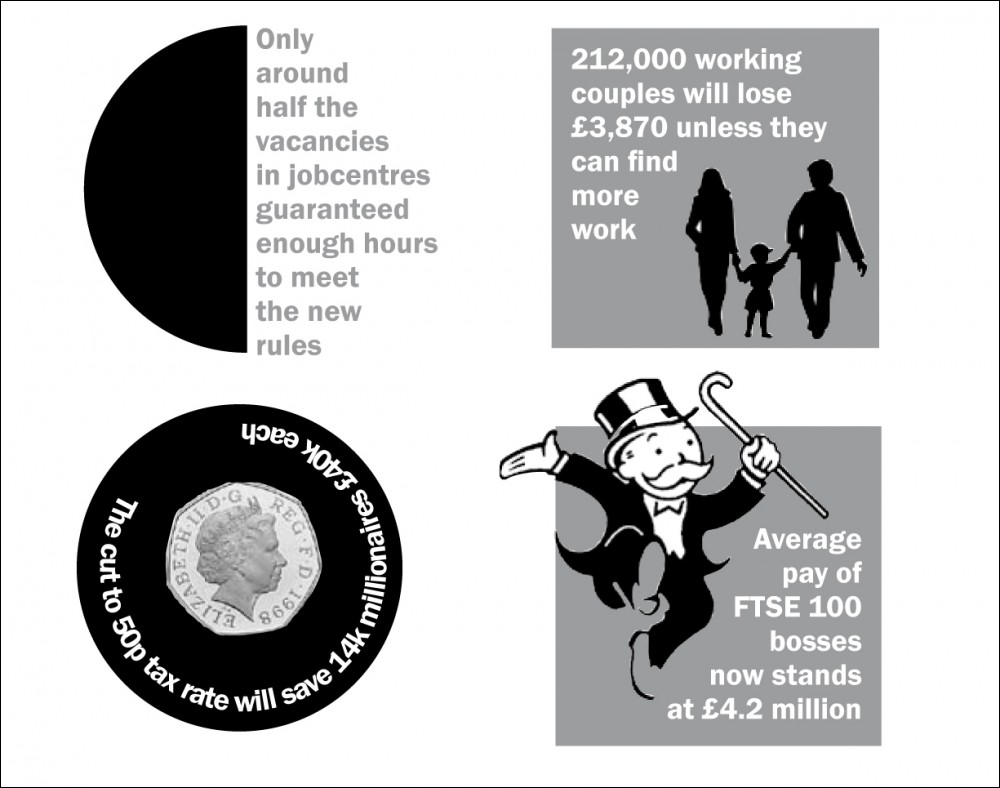
Also, up to 212,000 working couples (with a total of 470,000 children between them) who earn less than £17,000 a year will loseall their working tax credit, worth up to £3,870, unless they can increase their weekly working hours from 16 to 24.

In Austerity Britain, at a time when hours are being cut and workers laid off, how can low paid workers be expected to increase their hours to retain tax credits? A Guardian report which looked at 112,000 vacancies in job centres found that only 52% guaranteed enough hours to meet the new tax credit rules.

Moreover, research by the TUC shows that 1.3 million part-timers are seeking full-time work, the shop workers' union USDAW says that 78% of its part-timers can't get extra hours. It is all very well the TUC and trade unions telling us how bad things are - what they need to do is set up a mass campaign against these attacks on their members.

The Con-Dems are attempting to dress up changes to the welfare system as a way of encouraging the unemployed into work. However, these draconian cuts to tax credits will only affect those already working, making life even harder.

Charities are giving blunt warnings how low income working families will be battered by these changes. Even before these blows take effect Barnado's, the children's charity, shows that six out of ten children who live below the poverty line are in households where someone works.

A recent poll conducted by Netmums found that one in five mothers regularly missed a meal so their children could eat. Undoubtedly, this will include mothers from low-income working families.

Channel your anger!

Yet while ordinary families are suffering, the fat cats and their families are creaming it in. The cut in the 50p tax rate has saved 14,000 millionaires £40,000 each.

The average pay of a FTSE 100 boss now stands at £4.2 million. Then there's the £120 billion a year in tax avoidance, mainly by the rich, which has been highlighted by the PCS. Collecting this, for example, would make all cuts unnecessary.

That's why Trade Unionist and Socialist Coalition (TUSC) candidates are standing for a socialist alternative in order to stop cuts and positively transform the lives of the 99%. How we use the wealth in society should be planned to meet the needs of the overwhelming majority, not obscene profits for a few.

Don't let this anger we feel go to waste - let's put pressure on our trade union leaders to mobilise the strength of the millions-strong workers' movement to fight back.


A Supermarket Worker Describes Life on Workfare


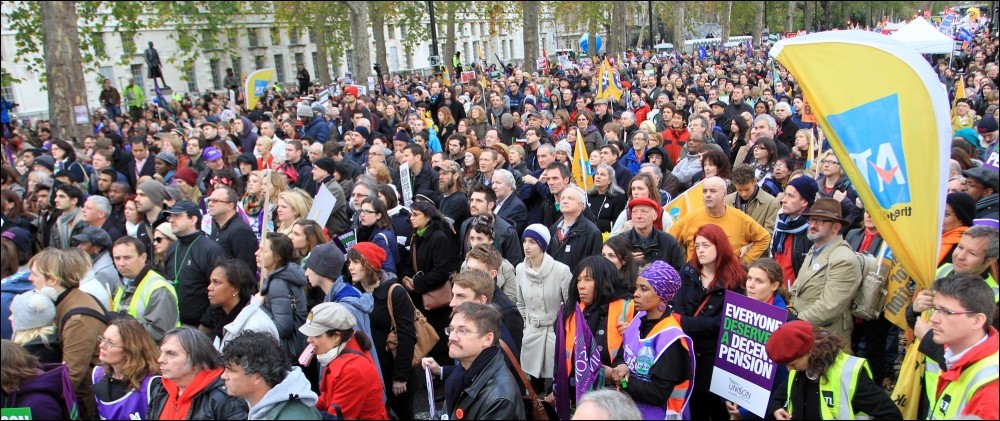
The Jarrow March for Jobs 2011 ends with a demonstration in London on 5 November , photo Sujeeth

The Jarrow March for Jobs 2011 ends with a demonstration in London on 5 November , photo Sujeeth (Click to enlarge)

I went on the government's workfare scheme out of sheer desperation, having been unemployed for over two years. My dad took early retirement so I had to start bringing more money in.

The first day was an eight-hour introduction. I had an interview but there was no guarantee that I'd even be able to work for free, many were turned away!

I didn't hear anything for weeks. Then out of the blue I got a call from the jobcentre, saying I had to start at Sainsbury's in the next couple of days.

I work on grocery, shelf stacking. My training lasted for 20 minutes, then I was doing the same job as everyone else for no pay. This lasted for six weeks. Out of all the people there who were either workfare or temporary I got a permanent, but part-time, job.

My day starts 4am. I leave the house at 4.30am if I haven't fallen back to sleep. I have to leave at this time to start at 6am because there are no buses at that time. Even if there were it would cost me nearly £10 a day to get to and from work, so I walk.

I spend my shift walking around the supermarket picking online orders.

I'm given 30 seconds for each product scan. This would be fine if the products were all in the same location and where they're supposed to be, if I don't have to substitute an item, or deal with a customer.

The scanner doesn't take into account the distance you have to walk and it doesn't start timing you when you start picking, it starts as soon as you log in the scanner. It doesn't account for getting to and from the warehouse.

If I over-run by a few minutes picking up the last items then I'll be in trouble with my manager. I'll receive a message over the scanner saying I am not keeping to pace.

We are usually finished by about 12pm. The fulltimers are not supposed to go home till 2pm so there is no need for them to insist on this unworkable pace. The only incentive to work this fast is fear that you'll lose your job!

When I've finished my shift I have an hour's walk to get home. Then I have to make a choice - do I try to stay awake, it's only about 2 or 3pm - or do I get some sleep? Like most people I'm living to work, not working to live.

Youth Fight for Jobs Demand:

  • No to workfare - for real jobs
  • No cuts to youth services
  • Bring back EMA - no to sky high university fees
  • Build affordable social housing

The pensions' battle continues


Socialism Today May 2012, photo by Paul Mattsson

Socialism Today May 2012, photo by Paul Mattsson (Click to enlarge)

The need for concerted strike action against Con-Dem cuts in the public sector is more urgent than ever. Central to that struggle is the ongoing battle to stop the government forcing workers to work longer, pay more and get less. PETER TAAFFE reports.

THE PENSIONS' BATTLE has been the centrepiece of the generalised struggle against government-imposed cuts over the last year.

This issue has generated the biggest phase of action so far, including strikes in 2011 in June and November.

The cuts also resulted in the biggest specifically working-class demonstration for generations on 26 March last year.

If, after these Herculean efforts of working people, the trade union movement was now to evacuate the scene of battle without deploying its full strength, it would be an enormous setback.

That could, in turn, bolster the government at a time when it is on the back foot. This would have serious consequences for the struggle against the panoply of cuts, more than 90% of which have yet to be introduced.

And yet this is precisely the danger which is posed by the defeatist approach of the right wing of the TUC, led by general secretary Brendan Barber, together with unions like Unison.

Their acceptance of the 'heads of agreement' on pensions, despite promises of future action, broke the common front on this issue.

Click here to read on

Thursday, 12 January 2012

Stephen Lawrence murder - the untold story

How socialists and the local community fought back against racism and the BNP

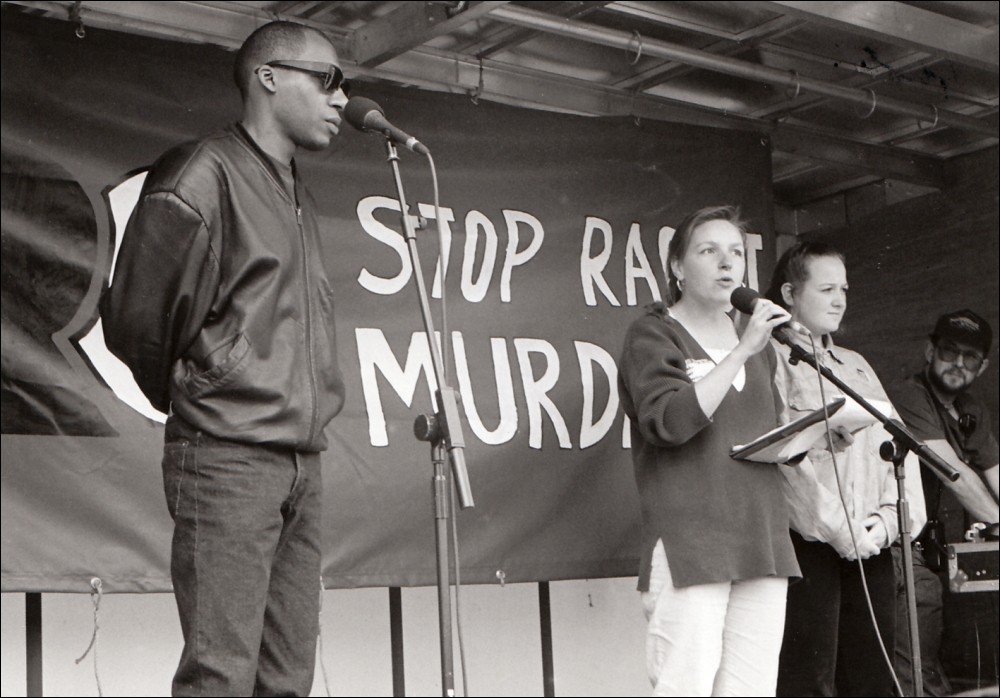
Youth Against Racism in Europe (YRE) and Panther platform in Welling campaign to drive the racists out after the murder of Stephen Lawrence, photo R. Newton

Youth Against Racism in Europe (YRE) and Panther platform in Welling campaign to drive the racists out after the murder of Stephen Lawrence, photo R. Newton (Click to enlarge)

On 3 January 2012 Gary Dobson and David Norris were found guilty of the horrific murder of black teenager Stephen Lawrence and sentenced to life imprisonment. Stephen was murdered almost 19 years ago in a racist attack by a white gang in south London.

Media coverage after the trial has focussed on the issues which emerged after the murder - such as institutionalised police racism and police incompetence, and how much has changed since. But there has been little mention of the presence of the far-right racist British National Party (BNP) in the area at the time and also the united community and trade union anti-racist campaign to drive them out.

Lois Austin, (pictured above, speaking) then a leading activist in Youth Against Racism in Europe (YRE) and the Labour Party Young Socialists, whose branches initiated the campaign, spoke to the Socialist:

Tuesday, 10 January 2012

Very Important - Next Steps in the Pensions Battle

Please see this brief report from PCS Left Unity conference on organising to continue the struggle against pension 'reforms' (work longer, pay more, get less) -

www.socialistparty.org.uk/articles/13440/08-01-2012/organising-to-step-up-the-pensions-struggle

And video of speech by Mark Serwotka: www.youtube.com/watch?v=oDmeTAu2HwY

Summary of the proposed offer:www.socialistparty.org.uk/articles/13377/21-12-2011/why-you-should-reject-the-pensions-deal-the-facts-for-workers-across-the-public-sector

Since then, Unite Local Government have rejected the offer. UNISON Local Government executive voted 24 - 10 to accept, this means they have agreed to accept the framework agreement which strips £900m from the scheme, as the basis for talks. Higher Education voted 6-5 in favour.

It is important to plan special conferences where the members can overturn the leadership decision.

Wording required from branches to call a special local government conference:

"This Branch requisitions a Special Conference of the Local Government Service Group to consider the policy of the Service Group in relation to the Local Government Pension Scheme."

Only this wording must be used nothing else no add ons or anything. Need to get branches representing 25% membership of each sector group. For other service groups delete local government and insert name of service group. To be sent to Heather Wakefield and Chris Tansley at UNISON HQ. Deadline is eight weeks from the first one being submitted, so eight weeks from now effectively.

Please feel free to share this post.

Tuesday, 3 January 2012

PCS Left Unity Conference open to all trade union members - building the campaign against attacks on pensions


Why you should reject the pensions deal


N30: millions of public sector workers went on strike on 30 November 2011, photo Senan

N30: millions of public sector workers went on strike on 30 November 2011, photo Senan (Click to enlarge)

Reject the pensions 'deal' - stay united - fight until we win!

  • When Lib Dem minister Danny Alexander put the government's pensions proposals to parliament on 20 December he said clearly that the government had achieved all its "savings goals" and would save tens of billions of pounds. That money is being stolen from public sector workers' pensions.
  • There is no increase in the 'cost ceiling'. This means that even where there have been some small improvements for some workers' accrual rates (the rate per year at which pension benefits are built up) they are being paid for by cuts in the pensions of other workers in the same scheme.
  • The amount that workers will have to pay into their pensions will still increase for all public sector pension schemes, by an average of 3.2% of salary, phased in over three years. This means that someone earning £25,000 will have to pay £800 a year more - effectively an immediate £800 per year pay cut! In health, the leadership of UNISON is claiming it has won a concession because those earning less than £26,000 will not have to pay more into their pensions for one year. However, even this puny concession is being paid for by higher paid public sector workers having to pay more.
  • The 'offer' ties retirement age to state pension age. This means that anyone born on or after 6 April 1960 but before 6 April 1961 will retire at between 66 and 67 years old. People born after 6 April 1961 will not get to retire until they are 67 or older.
  • Pensions will be linked to the CPI rather than the RPI inflation index. This will mean that over an average 20-year retirement, pensions will be worth up to 20% less.
  • In local government the government has agreed to delay implementing these attacks by a year, until 2014, but only on the basis of the unions signing up now to misery a year down the line.
  • This attack is not about the cost of the schemes, but about the government's attempts to make public sector workers pay for a crisis they didn't create!

Click here to read on